Returning Adult Learners are identified as undergraduate students over the age of 25 seeking their first undergraduate degree.
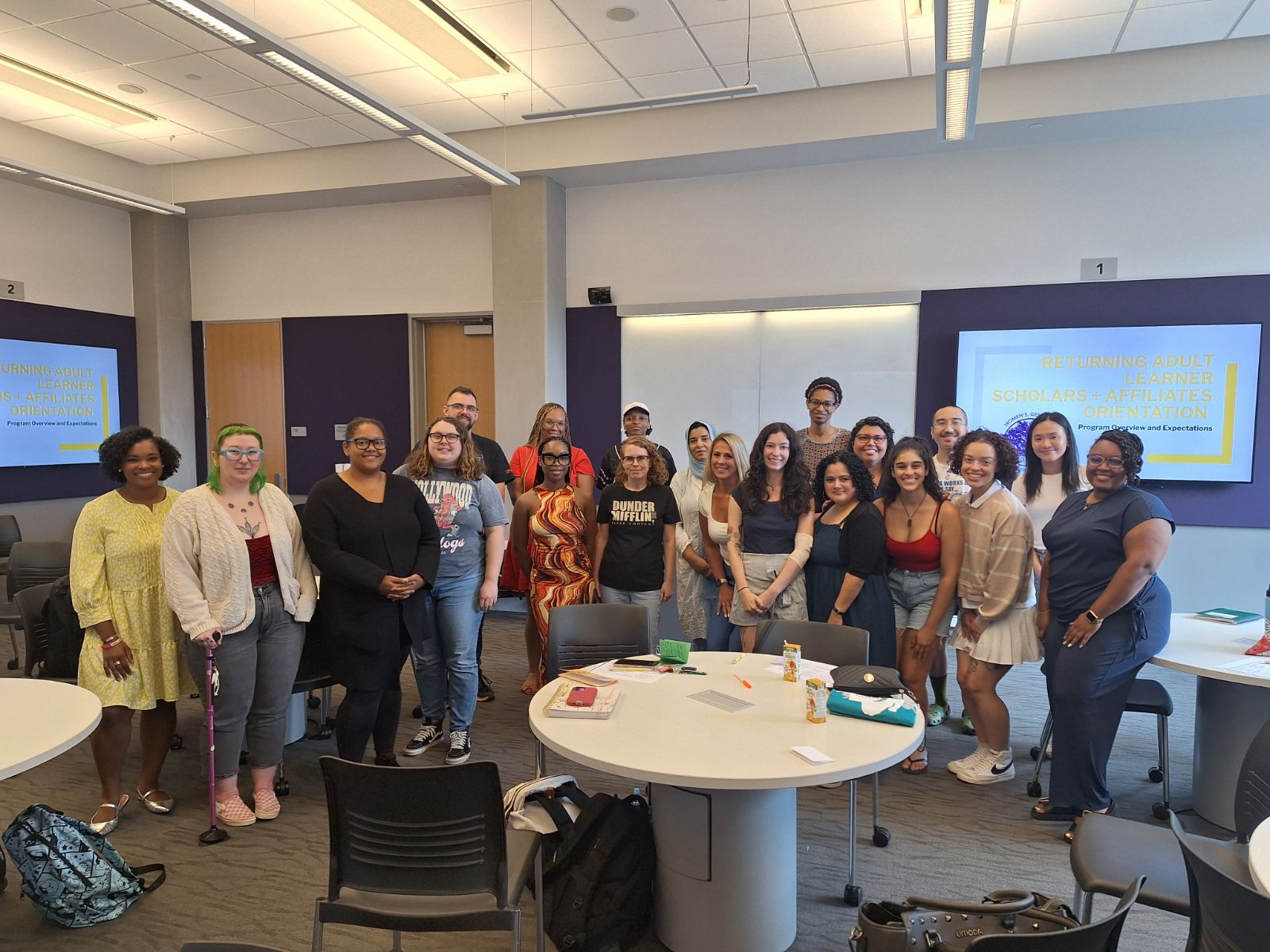
The Returning Adult Learners Program & Scholarship at the Women’s, Gender, and Equity Center (WGEC) offers monthly workshops and programs that focus on the academic, personal, and professional aspects of life as nontraditional students. Programs include topics such as career navigation, networking events, financial management, and personal well-being and care. We encourage adult learners at UMBC (including our USG students!) to participate in virtual monthly workshops and events tailored to this population. For more information on how to get involved, join the Women’s, Gender, & Equity Center myUMBC group, or follow us on Instagram @womencenterumbc.
The WGEC offers many different resources and services to students on campus, including all students who identify as a Returning Adult Learner (RAL). These include, but are not limited to, one-on-one advocacy support, access to the “free shelf” containing menstrual and first aid products, and connectivity to our lounge area which offers a kitchenette, free public library, a meditation/prayer/lactation room, and space to decompress. The WGEC also hosts nine identity-based social support/discussion groups.
Scholarship Resources
 The Women’s, Gender, and Equity Center offers several scholarship opportunities for undergraduate students 25 years of age or older, seeking their first undergraduate degree.
The same application is used for the following applications: the AEGON Scholarship, Charlotte W. Newcombe Scholarship for Mature Students in STEM, Jodi Robyn & David F. Mister – Charlotte W. Newcombe Endowed Scholarship, Richard and Roselyn Neville Memorial Fund, and the Rosalie Tydings Business and Professional Women’s Scholarship Endowment Fund.
The application generally opens March 1st and closes May 30th. This application can be found on Scholarship Retriever. Eligibility requires that all applicants must be over the age of 25, have earned at least 60 credits, have at least a 2.5 GPA, and be working towards their first undergraduate degree.
If a student is not eligible, the scholarship opportunity will not appear on Scholarship Retriever. Students who have not completed the FAFSA will not see the opportunity in Scholarship Retriever. Students who wish to still be considered despite not meeting these requirements should contact the Women’s, Gender, and Equity Center directly. This encouragement to reach out directly extends to students who have extenuating circumstances (i.e. students who are DACA/undocumented) that may prevent them from completing the FAFSA.
Scholars Program Requirements for All Scholarships Awardees:
- If you are selected as a scholarship recipient, you will be required to sign the Women’s, Gender, and Equity Center Scholarship Agreement Form and any other additional forms required by the Office of Financial Aid and Scholarship before receiving the award.
- Recipients will be required to write a short biography to be used for grant and programming purposes. Additional instructions will be provided in the post-acceptance forms.
- Students must agree to comply with the Returning Adult Learner Scholars Program requirements (many of which can be completed virtually) outlined in the Women’s, Gender, and Equity Center Scholarship Agreement Form. These requirements include:
- Meeting one-on-one with a professional staff member at the Women’s, Gender, and Equity Center at least once per semester
- Attending an orientation and end-of-semester celebration in both the fall and spring semesters
- Attending at least two Returning Adult Learner events each semester
Select students who are not awarded a scholarship may be invited to join the Returning Adult Learners Scholars Program as an affiliate member. Affiliate members receive many of the same benefits as the scholars in an effort to support adult learner retention, graduation, and belonging.
Download our brochure about the RAL Scholarship here!
Additional Resources for Returning Adult Learners
We have highlighted a list of resources that are often used by our students but encourage everyone to stop by and say hello if you have any questions.
There is much overlap regarding commuter students and Returning Adult Learners. The Division of Student Affairs, in the department of Student Engagement and Belonging, Commuter Connections staff and students have put together a Commuter Thrive Guide that can serve Returning Adult Learners in the same capacity.
Additional on and off-campus resources:
- Departmental Advising
- Office of Disability Access & Resources (formerly the Office of Student Disability Services)
- UMBC Psychology Training Clinic
- Office of Academic Opportunity Programs & McNair Scholars and Student Support Services
- Opportunities for applied learning at the Shriver Center
- Y Preschool at UMBC
- Maryland Department of Human Services (SNAP/WIC)
In addition to our private lactation room at the Center, nursing parents can access other similar spaces on the 7th floor of the Library (Room 755), the ground floor of the RAC (Room 073) on the main campus, or the wellness room at Shady Grove’s campus. The Maryland Family Network can also assist you in locating childcare closer to where you live. This American Association of University Women (AAUW) program is a great tool to teach you about salary negotiation.
This is not an exhaustive list. The Women’s, Gender, and Equity Center Staff is available to assist you locating services should you need help with resources not listed here.